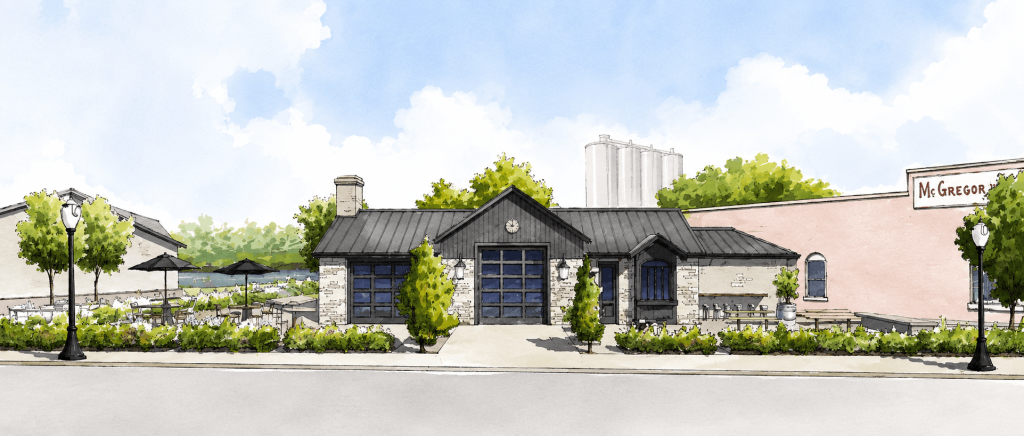
It starts with the Mississippi.
Before the railroads, before the settlers, the river belonged to the people who knew it first. The Sioux, the Sauk, the Meskwaki, the Ho-Chunk, they lived on this water, traded on it, built their lives around it. They carved effigy mounds into the bluffs overlooking the river, that are still there today, over a thousand years later.
The Mississippi was never just a route. It was home.
Later, paddleboats and steamboats moved people and grain and ambition up and down the Mississippi, and the bluffs rising 500 feet on either side made it one of the most stunning corridors in America. Passengers lined the decks just to watch these ancient walls of limestone pass. This wasn’t just commerce. It was spectacle.
And McGregor sat right in the middle of it.
The History
Founded in 1847 by Alexander MacGregor — a Scottish immigrant, a descendant of Rob Roy MacGregor — who saw a river crossing and built a community around it. By the 1870s, McGregor was the busiest shipping port west of Chicago. Population over 5,500. A hundred and twenty businesses. Trains coming from the west were literally disassembled and ferried across the Mississippi on boats, one of the most critical chokepoints in westward expansion.
But the layers of history here are almost too absurd for a town this small. Think about what MacGregor did. He wasn’t from Iowa. He was a Scotsman who saw a river crossing and built a world around it. The Ringling Brothers were kids in a harness maker’s shop who saw a showboat pull up to the dock and imagined something bigger. Andrew Clemens, deaf since childhood, scraped sand from the bluffs and made art that stunned the world. Frank Lloyd Wright was a toddler here before he became Frank Lloyd Wright.
McGregor has always been where people arrived and became something. A launching pad disguised as a destination.
Then the railroad moved on. And everyone forgot.
We didn’t.
The Roots
When people experience where they come from, or where anyone comes from, something shifts. It’s not nostalgia. It’s recognition. The railroad age taught us that progress means moving through places as fast as possible. We’re making the opposite argument: the deepest experience comes from stopping. From being immersed in a place’s story. From feeling the layers of time in a single location.
There’s something universal about sand. We’re all grains. Individually tiny, unremarkable. But when someone with vision arranges us, when community happens, when roots take hold, something emerges that’s greater than any single grain could be. Clemens couldn’t glue his sand. Those bottles held the grains together through pressure and proximity. Each grain leaning against the next.
And the Mississippi Lotus. It grows in mud. Roots in the dark, underwater, in the muck at the bottom, and blooms above the surface into something extraordinary. The yellow lotus disappeared from these backwaters. But its seeds held in the riverbed for centuries. When conditions were right, it came back enormous.
That’s McGregor. That’s us.
That’s community. That’s roots.
The Legacy
Every building we’re restoring is a chapter that got interrupted. The Alexander Hotel, where travelers stayed on their way west. The Sullivan House Opera House, where a community gathered. The original post office that connected a frontier town to the rest of the country. These aren’t renovation projects. They’re sentences that stopped mid-word.
We’re picking up the pen.
We’re restoring McGregor because some stories are too important to only be read about; they need to be lived. This town sat at the crossroads of American expansion, and the same forces that built it up left it behind. By restoring its buildings, honoring its history, and using immersive technology to make that history feelable, we’re proving that a small town’s story still has the power to move people, not just in the summer, but all year long. They’ll say we have no business restoring a town. They’ll say immersive technology belongs in Vegas, not Iowa. They’ll say you can’t turn a seasonal river town into a year-round destination.